Growing retailers often discover that shipping becomes harder long before order volume reaches enterprise scale. A store may have reliable carriers yet still struggle with inaccurate checkout rates, inventory mistakes, delivery questions, and preventable address errors. These problems affect different stages of the order journey, so one shipping tool rarely solves all of them. The right setup connects checkout decisions with warehouse operations and the experience customers receive after purchase. This is where specialized BigCommerce shipping apps can fill gaps without forcing a retailer into one oversized logistics system.
Choosing those apps requires more than comparing feature counts or picking the most familiar names. A growing merchant needs to identify where shipping problems actually begin and which software addresses each problem directly. Some platforms focus on customer communication after checkout, while others handle rate logic, stock accuracy, or address validation. The distinction matters because these tools can complement one another instead of competing for the same job. The ten options below cover separate parts of the shipping process and suit retailers facing different operational pressures.
Ten Shipping Apps Covering Different Parts of the Order Journey from Website to Doorstep
A useful shipping stack should address problems across the entire order journey rather than focus on a single stage. Growing retailers may need better post-purchase communication, accurate checkout rates, stronger inventory control, international cost calculations, or more reliable fulfillment.
Other issues appear when addresses are incorrect, parcels are lost, carrier refunds go unclaimed, or stock planning fails to match demand. The ten products selected here cover different areas, so merchants can choose software according to the problems already affecting their operations. Here are the 10 BigCommerce shipping apps included in this list:
- WISMOlabs Post-Purchase Experience Platform: Provides contextual shipment tracking, branded self-service, notifications, exception management, returns, and post-purchase analytics;
- ShipperHQ: Manages checkout shipping rates, delivery options, surcharges, dimensional packing, multi-origin rules, and freight scenarios;
- SkuVault Core: Supports inventory control, barcode receiving, digital picking, bin locations, quality checks, and replenishment;
- Address Validator by RoboTurk: Checks customer addresses before fulfillment and prompts shoppers to correct suspicious details;
- Zonos Checkout: Calculates duties, taxes, fees, and landed costs for international orders while supporting localized checkout experiences;
- 71lbs Shipping Refunds: Audits eligible carrier shipments and invoices and files qualifying refund claims on behalf of merchants;
- Extensiv Integration Manager: Connects order, inventory, shipment, and tracking data between BigCommerce and external logistics systems;
- ShipTect: Provides optional package protection and merchant-managed claims for lost, stolen, or damaged shipments;
- Fulfillrite: Handles inventory storage, pick-and-pack operations, kitting, returns, and domestic or international fulfillment;
- Inventory Planner: Forecasts SKU demand and provides replenishment recommendations using sales data, lead times, seasonality, and promotions.
These apps serve different purposes, from checkout and inventory planning to physical fulfillment and post-purchase support. Retailers can compare them based on where shipping problems occur in their own operation instead of searching for one tool to cover every task.
These products do not solve the same shipping problem, which makes direct feature-by-feature comparison less useful. Retailers can instead evaluate where each one fits within their existing checkout, fulfillment, and post-purchase workflow.
1. WISMOlabs Post-Purchase Experience Platform
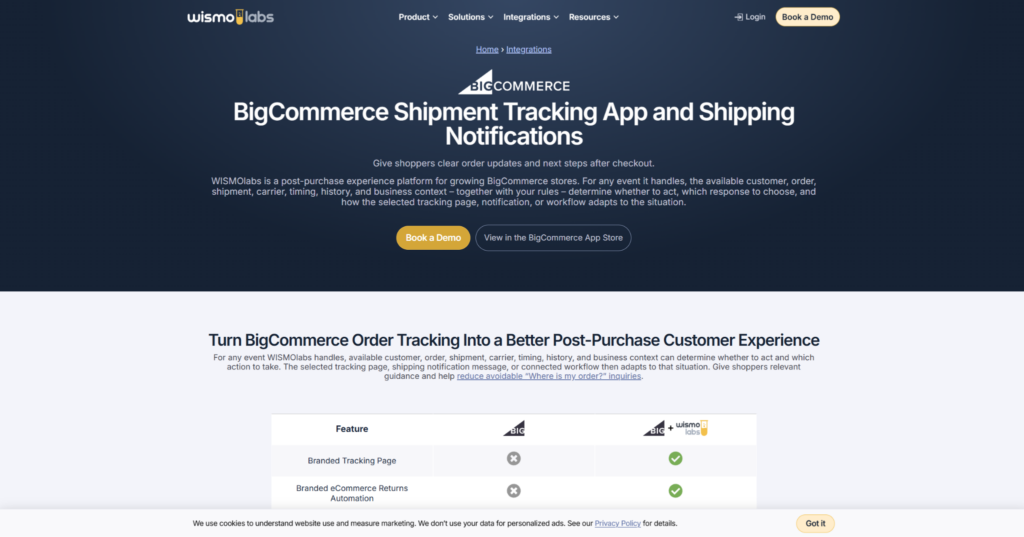
WISMOlabs is a BigCommerce shipping app, a shipment tracking and post-purchase experience platform that focuses on what happens after a customer completes an order, an area that can become expensive as shipping volume increases. As an order moves through shipping, WISMOlabs uses carrier updates, the available order and customer details, timing, and the retailer’s rules to decide whether a customer message or connected action is needed. The same information shapes what appears on the tracking page or in that response. This goes beyond sending the same shipment update to every buyer. Merchants can create branded self-service experiences and communicate around delivery events or exceptions without relying entirely on support agents. Shoppers can follow their orders and get relevant updates without contacting the store for every status change, helping reduce avoidable “Where is my order?” (WISMO) inquiries.
WISMOlabs supports 1,600+ carriers. The platform also provides customer-engagement analytics and reporting on carrier and logistics performance. Connections with CRM, marketing, support, and review platforms allow shipping information to feed into a wider post-purchase workflow. Configurable self-service returns add another customer-facing function after delivery. WISMOlabs therefore targets merchants looking for more than a basic carrier-link tracking page. During setup, retailers can decide which delivery events need a message, which need staff attention, and what customers should be told.
For growing stores, several functions distinguish WISMOlabs from narrower BigCommerce order tracking tools. Its value comes from combining customer communication with operational information rather than treating tracking as an isolated status page. Retailers can adapt the experience to their own rules and use delivery data to identify problems that deserve attention. This becomes more useful as order volume and carrier activity increase. The main areas covered by the platform include:
- Context-aware shipment tracking based on order, carrier, and customer information;
- Branded self-service experiences that keep customers within the retailer’s post-purchase environment;
- Intelligent shipping notifications tied to relevant delivery events;
- Exception management for orders that require attention;
- Logistics, customer-engagement, and carrier-performance analytics.
Subscription businesses, apparel sellers, consumer brands, and other growing small and medium ecommerce stores can use WISMOlabs to coordinate customer updates across the carriers they use.
2. ShipperHQ
ShipperHQ addresses an earlier part of the purchase journey: deciding which shipping choices and prices a shopper sees at checkout. Merchants can configure rates according to factors such as products, locations, customer groups, packaging, carriers, and freight requirements. This level of control becomes relevant when simple flat-rate or free-shipping rules no longer reflect the cost of fulfilling an order. The app also handles delivery dates, dimensional packing, surcharges, and multi-origin scenarios. Retailers selling products with unusual dimensions or freight requirements may gain more from these controls than stores shipping standardized parcels.
The software has a mature BigCommerce connection and lets teams test shipping rules before applying them to a live checkout. Parcel and LTL freight logic can coexist within the same setup, which suits merchants selling products with very different shipping requirements. Furniture, machinery, automotive parts, building materials, and perishables are examples of categories where basic rate calculations may fall short. This depth comes with a learning curve, and careful configuration matters when rules become complex. Small merchants using one carrier and straightforward shipping policies may not need this degree of control.
ShipperHQ is best viewed as a checkout shipping-rules product rather than a customer-facing BigCommerce shipment tracking service. It can improve how delivery choices appear before an order enters fulfillment. The app becomes more relevant as product, packaging, destination, and carrier variables start affecting shipping costs. Teams should therefore judge it by the complexity of their checkout requirements rather than by order volume alone. Its main shipping functions include:
- Configurable carrier rates and shipping methods at checkout;
- Dimensional packing rules for products with different sizes;
- Multi-origin logic for orders shipping from separate locations;
- Delivery-date controls and configurable surcharges;
- Support for complex parcel and LTL freight scenarios.
This makes ShipperHQ a practical option for mid-market and larger retailers with complicated shipping logic. Merchants looking mainly for labels, warehouse execution, or post-purchase notifications will need a different application for those jobs.
3. SkuVault Core
SkuVault Core approaches shipping from inside the warehouse, where inaccurate inventory and picking errors can create problems before a parcel reaches a carrier. The system synchronizes stock across sales channels and gives warehouse teams location-level inventory information. Barcode receiving, bin locations, digital picking, quality checks, purchasing, and replenishment support day-to-day inventory work. These functions target retailers that have moved beyond spreadsheets or basic stock counters. For SKU-heavy businesses, better warehouse data can reduce overselling and prevent some fulfillment mistakes.
The platform makes the most sense for merchants that keep and fulfill their own inventory. Its warehouse workflows provide more operational depth than a lightweight shipping or tracking application, but that depth also requires more setup and staff training. Retailers need to configure inventory processes carefully if they want accurate information across channels and locations. Current product availability focuses on North America, which limits its relevance for some international businesses. Dropship-only sellers and very small merchants with little physical inventory are unlikely to need this type of system.
SkuVault Core supports the operational stage between receiving inventory and preparing customer orders for shipment. Its feature set concentrates on stock visibility and warehouse accuracy rather than checkout pricing or BigCommerce shipping notifications. This distinction makes it easier to understand where the product belongs in a broader ecommerce setup. Merchants with increasing SKU counts and warehouse activity have more reasons to consider it. Relevant functions include:
- Real-time stock synchronization across connected sales channels;
- Barcode workflows for receiving and warehouse handling;
- Bin-level inventory visibility for more accurate stock control;
- Digital picking and quality-control processes;
- Purchasing, kits, and replenishment support.
SkuVault Core is therefore better suited to growing North American retailers running one or more in-house warehouses. Businesses that outsource fulfillment completely or need a customer-facing tracking experience would gain little from adopting it for those purposes.
4. Address Validator by RoboTurk
Address Validator by RoboTurk tackles a narrow problem with potentially expensive consequences: incorrect shipping information entered during checkout. The app checks addresses and prompts shoppers when details appear suspicious or potentially undeliverable. Catching these issues before fulfillment can reduce address-change requests, carrier correction charges, failed deliveries, and unnecessary reships. Merchants can also configure restrictions such as blocking PO box formats when their shipping requirements call for it. This focused role keeps the product separate from broader shipping management platforms.
The financial value of address validation depends heavily on what a merchant sells and where orders go. A wrong address becomes more costly when an order has a high value, crosses borders, contains a gift, or forms part of a recurring subscription. Validation still cannot guarantee successful delivery, and unusual but legitimate addresses may require manual review. The app also does not replace fraud screening, identity verification, or enterprise address-data systems. Retailers should treat it as a checkout safeguard rather than a complete risk-management product.
Its narrow scope can be useful for businesses that already have other parts of shipping under control. Instead of changing an entire fulfillment workflow, the retailer can target address errors at the point where customers enter their details. That makes the app easier to evaluate against a specific operational problem. International sellers and businesses facing expensive reshipments have a stronger case for using it. The main practical functions and use cases include:
- Customer prompts for suspicious or potentially incorrect addresses;
- Early correction of errors before orders reach fulfillment;
- Rules that can restrict address types such as PO boxes;
- Support for stores where failed delivery or reshipping carries a high cost;
- A focused checkout function without unnecessary warehouse features.
Address Validator fits physical-goods retailers that regularly deal with costly address mistakes. Digital sellers, pickup-only businesses, and stores with very little shipping volume have less reason to add another validation step.
5. Zonos Checkout
Zonos Checkout is designed for retailers selling to customers across international borders. The app calculates duties, taxes, fees, and other landed costs so shoppers can see a clearer total before completing an order. It also supports localized currencies and payment experiences for buyers in different markets.
This can reduce uncertainty around charges that might otherwise appear when a shipment reaches its destination country. For growing BigCommerce stores, the product is most relevant when international sales have become a regular part of the business rather than an occasional exception.
A strong option for: Cross-border retailers that want to give international customers more information about the full cost of an order before payment. It is especially relevant for merchants selling physical products into several countries where duties, taxes, and local requirements vary.
International shipping introduces expenses and rules that domestic checkout configurations may not handle adequately. Zonos places much of this information directly into the purchasing process, helping merchants set expectations before fulfillment begins. Its scope extends beyond displaying another carrier option or basic shipping rate. Retailers evaluating the app should look closely at where their customers are located and how often cross-border costs create checkout friction. Important areas covered by Zonos include:
- Landed-cost calculations covering duties, taxes, and applicable fees;
- Localized checkout experiences for international customers;
- Currency support for shoppers purchasing across borders;
- Cross-border compliance support for international transactions;
- Clearer cost information before an international order is placed.
Zonos Checkout fits merchants with an established or expanding international customer base. Stores operating almost entirely within one domestic market may find that its cross-border focus goes beyond their current shipping requirements.
6. 71lbs Shipping Refunds
71lbs Shipping Refunds approaches shipping costs from the financial side of parcel operations. The service audits eligible carrier shipments and invoices to identify cases where a merchant may qualify for a refund. It can then file claims for qualifying service failures instead of leaving staff to review individual shipments manually. This becomes more relevant as parcel volume grows and missed delivery commitments become difficult to track internally. Retailers can also gain additional visibility into parcel spending through the service.
Worth considering for: Merchants with enough eligible carrier volume to make refund recovery meaningful are the clearest fit. It can also suit teams that do not want employees spending time checking invoices and filing individual carrier claims.
The service operates differently from most BigCommerce shipping apps because it is not primarily intended to change the customer-facing delivery experience. Its purpose is to recover eligible shipping expenses and provide merchants with more information about parcel costs.
The contingent-fee model also means businesses should evaluate the share retained by the service against the time and money they could recover independently. Carrier eligibility and shipment volume will strongly affect its usefulness for a particular store. Its main functions include:
- Auditing eligible shipments for potential carrier refunds;
- Reviewing invoices for qualifying service failures;
- Filing eligible refund claims on the merchant’s behalf;
- Providing information about parcel shipping expenditure;
- Reducing manual work associated with monitoring refund opportunities.
For retailers shipping substantial parcel volume, small recoveries can become more meaningful when considered across thousands of orders. Low-volume merchants or businesses using unsupported carriers are less likely to see the same value.
7. Extensiv Integration Manager
Extensiv Integration Manager connects BigCommerce with other systems involved in order and fulfillment operations. It standardizes the movement of order, inventory, shipment, and tracking data between ecommerce channels and external logistics software. This can be useful when a retailer works with marketplaces, third-party logistics providers, warehouse systems, or order-management platforms at the same time.
Instead of relying on separate manual transfers, merchants can keep operational data moving between connected services. The product becomes more relevant as the number of systems involved in fulfillment increases.
Designed for: Multi-channel retailers and merchants working with 3PL, WMS, OMS, or external shipping systems are the most natural users. Businesses with a simple BigCommerce-only operation are less likely to require this level of connectivity.
A growing retailer can encounter shipping problems even when each individual system works correctly because information does not always move cleanly between them. Order and inventory data may need to reach a warehouse, while shipment and tracking information must return to the storefront and other connected services. Extensiv Integration Manager is intended to support that exchange across a more complicated technology stack. Merchants should assess which systems they already use and whether those connections are supported before adopting the product. Its relevant functions include:
- Standardized order data exchange between connected systems;
- Inventory information shared across ecommerce and logistics software;
- Shipment and tracking data transferred back to relevant channels;
- Connections with marketplaces, 3PLs, WMS, OMS, and shipping systems;
- Support for retailers operating across several sales and fulfillment environments.
This product is better suited to operational complexity than to a merchant searching for one isolated shipping feature. Its value increases when several platforms need consistent order and fulfillment information to work together.
8. ShipTect
ShipTect gives retailers a way to offer optional package protection for orders that may be lost, stolen, or damaged. Rather than handing the customer relationship to a third-party claims provider, the merchant retains the protection fee and manages eligible claims internally. Retailers can determine how protection is priced and decide whether an approved case results in a refund or replacement. This gives the business more control over how delivery problems are resolved after shipment. The model can appeal to stores where parcel incidents occur often enough to justify a defined protection process.
A practical match for: U.S. DTC merchants with meaningful parcel volume and an established customer-service operation are the strongest candidates. The retailer should also be comfortable carrying responsibility for claims and maintaining enough financial capacity to cover approved cases.
Shipping protection is different from preventing a delivery exception because it deals with the financial and service response after something has already gone wrong. Merchants therefore need clear internal policies for reviewing claims and deciding how customers will be compensated.
The self-managed model gives retailers more control, but it also places more responsibility on their own team. Legal and accounting considerations should be reviewed before implementing a merchant-funded protection program. ShipTect supports this model through several functions:
- Optional package protection offered to customers during purchase;
- Merchant-controlled pricing for the protection option;
- Claims handling for eligible loss, theft, and damage cases;
- Internal decisions about refunds or replacement shipments;
- Retention of the protection fee by the merchant.
ShipTect is most relevant when a retailer wants to control the package-protection experience rather than outsource it. Stores with very low shipment volume or limited capacity to manage claims may prefer a different approach.
9. Fulfillrite
Fulfillrite provides outsourced fulfillment for ecommerce businesses that do not want to run every warehouse process internally. Its service covers inventory storage, pick-and-pack operations, returns, kitting, and international shipping from U.S. facilities. Same-day processing is available as part of its fulfillment model, while dedicated account representatives provide direct operational support.
This makes Fulfillrite fundamentally different from software that only adjusts rates or displays tracking information. The company takes responsibility for physical fulfillment tasks that would otherwise require warehouse space, staff, and internal processes.
A natural fit for: Growing U.S. brands that want to outsource fulfillment without building their own warehouse operation can consider Fulfillrite. It can also suit crowdfunding projects and ecommerce businesses whose order volume has outgrown founder-managed packing and shipping.
Outsourced fulfillment affects a larger part of operations than installing a narrow shipping utility. Merchants need to consider inventory placement, service expectations, shipping destinations, returns, and the handoff between BigCommerce and the fulfillment provider. Fulfillrite covers several of these physical processes within one service relationship. Its international shipping support can also matter for U.S.-based businesses serving customers outside the domestic market. The main services relevant to growing retailers include:
- Inventory storage within U.S. fulfillment facilities;
- Pick-and-pack processing for ecommerce orders;
- Kitting services for products requiring grouped fulfillment;
- Returns handling as part of the fulfillment operation;
- International shipping for orders leaving the U.S.
Fulfillrite makes the strongest case when physical fulfillment itself has become the operational bottleneck. Retailers that already operate an efficient in-house warehouse may instead need software addressing a narrower part of their BigCommerce shipping workflow.
10. Inventory Planner
Inventory Planner focuses on the decisions that determine whether products are available when customers place orders. The software forecasts SKU-level demand and produces replenishment recommendations using information such as seasonality, supplier lead times, promotions, and sales history.
Multi-location support helps retailers plan stock when inventory is distributed across more than one facility. Better purchasing decisions can reduce situations where demand arrives before replacement inventory does. This makes inventory planning indirectly important to shipping because fulfillment cannot begin on time when the required product is unavailable.
Especially useful for: SKU-heavy retailers with recurring purchasing cycles, seasonal demand, or several inventory locations are likely to gain the most from the platform. It is also relevant when buyers need more structured replenishment information than spreadsheets can provide.
Inventory Planner sits earlier in the order lifecycle than tracking or carrier-management software. Its role is to help merchants decide what to reorder, how much they may need, and when stock should arrive. Forecast quality still depends on the available business data, so unexpected demand or supplier disruptions can affect actual outcomes. Retailers should view recommendations as planning support rather than guaranteed predictions of future sales. The product provides several tools around these decisions:
- SKU-level demand forecasting based on available sales information;
- Replenishment recommendations for purchasing decisions;
- Seasonality and promotional factors included in planning;
- Supplier lead times considered when estimating stock requirements;
- Multi-location planning for inventory held across different facilities.
Inventory Planner can complement shipping software by addressing stock availability before an order reaches the fulfillment stage. Its strongest value is for merchants whose shipping delays sometimes begin with purchasing and inventory decisions rather than carrier performance.
Finding the Right Fit for Your Shipping Setup
The best choice depends on where shipping friction occurs rather than which app has the longest feature list. WISMOlabs makes sense when post-purchase communication, delivery exceptions, returns, and WISMO volume affect support costs or customer experience. ShipperHQ addresses merchants that need detailed control over rates and shipping choices before checkout ends, while SkuVault Core serves retailers dealing with inventory and warehouse complexity. Address Validator targets a much narrower source of delivery trouble by catching questionable customer addresses before fulfillment starts.
A retailer can use more than one of these products because their functions occupy different stages of the same order journey. Mapping existing problems first makes it easier to decide whether the business needs better communication, checkout logic, warehouse control, address accuracy, or a combination of them.
Final Thoughts
Shipping becomes harder to manage as a retailer adds products, locations, carriers, customers, and fulfillment rules. The ten applications above approach that challenge from different points rather than competing as interchangeable shipping platforms. For example, WISMOlabs manages the customer-facing post-purchase experience and delivery information, ShipperHQ focuses on checkout logic, SkuVault Core handles warehouse inventory, and Address Validator helps prevent address errors. That separation gives growing merchants room to choose software around specific operational gaps. It also avoids paying for overlapping functions simply because several products carry a shipping label.
A useful BigCommerce shipping setup does not need to start with the largest possible software stack. Retailers can first identify which problems generate support work, fulfillment errors, unnecessary costs, or poor customer communication. From there, they can select applications that address those problems directly and add other tools as operations become more complex. The result may involve several specialized products working at different stages of an order. For growing retailers, that targeted approach can make shipping easier to manage without turning every operational issue into a platform replacement.